Pasturmas verbindet Geschichte, Kultur und Lebensfreude. Das gepökelte, luftgetrocknete Fleisch mit seiner unverwechselbaren Schicht aus Gewürzen ist weit mehr als nur eine Delikatesse. Es erzählt von Handelsrouten, nomadischen Völkern und kulinarischen Traditionen, die sich über Jahrhunderte hinweg durch Zentralasien, Anatolien und die Balkanhalbinsel bis nach Griechenland ausbreiteten.
Von HB-Redakteurin Maria Vlachou
Griechisch kochen – Heute ist Pasturmas (oder Pastroumas) fester Bestandteil der griechischen Meze-Kultur, wo er mit Ouzo, Raki oder Tsipouro serviert wird – als würziges Symbol einer geteilten Geschichte zwischen Ost und West.
Der Ursprung des Pasturmas reicht weit zurück in die Welt der zentralasiatischen Nomadenstämme. Sein Name leitet sich vom türkischen Ausdruck pastırma et ab, was „gepresstes Fleisch“ bedeutet – ein Hinweis auf die ursprüngliche Zubereitungsmethode: Das Fleisch wurde unter dem Sattel des Reiters aufbewahrt, wo es durch Druck und Wärme gepökelt und haltbar wurde.
Mit den wandernden türkischen Stämmen gelangte diese Technik über Anatolien bis in das byzantinische und später das osmanische Griechenland. Früheste schriftliche Hinweise stammen aus Thrakien (1624) und Konstantinopel (1640). Von dort verbreitete sich Pasturmas rasch über den gesamten Balkan.
In Nordgriechenland, besonders in Regionen wie Makedonien, Drama und Kavala, entwickelten sich eigene Varianten. Hier wurde Rind oder Lamm bevorzugt, während in Anatolien auch Kamel- oder Ziegenfleisch üblich war. Die griechischen Produzenten verfeinerten die Methode, indem sie lokale Gewürze wie Knoblauch aus Drama und Paprika aus Florina in die aromatische Gewürzpaste einarbeiteten.
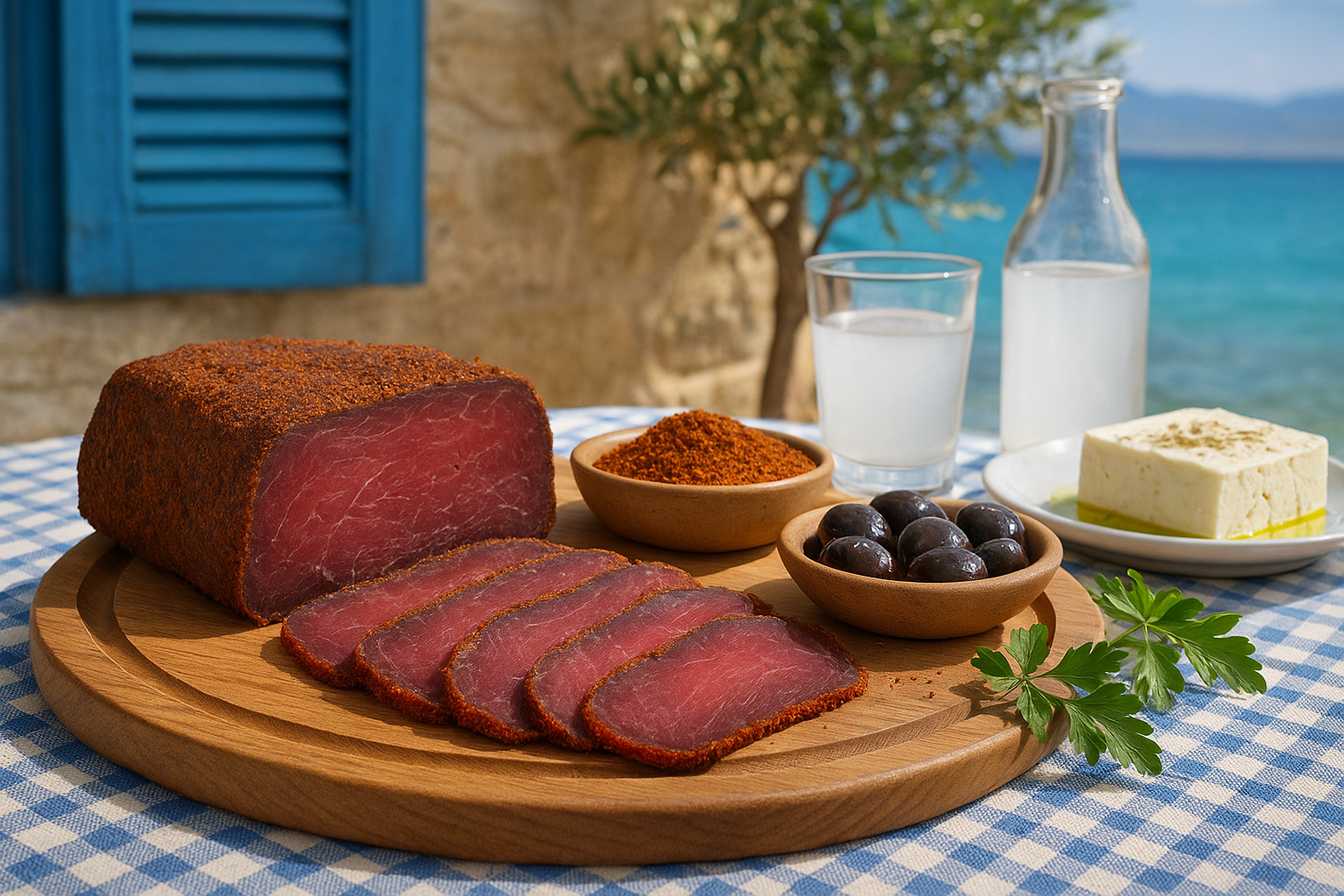
Die Kunst des Pasturmas beginnt mit der Auswahl des richtigen Fleisches – meist Rinder- oder Lammrippen, seltener Büffel- oder Kamelrippen, deren zarte Struktur das typische Aroma ermöglicht. Das Fleisch wird zunächst gesalzen, gepresst und anschließend getrocknet, wodurch es an Gewicht verliert und seine charakteristische Dichte erhält.
Der entscheidende Schritt ist jedoch das Einreiben mit der çemen-Paste, einer intensiv duftenden Mischung aus Kreuzkümmel, Knoblauch, Bockshornklee (dem namensgebenden „çemen“), Paprika und manchmal auch Rainfarn. Es gibt zahlreiche Mischungen. Diese Gewürzkruste schützt das Fleisch vor Verderb, verleiht ihm seine dunkelrote Farbe und das unverwechselbar würzige Aroma.
Traditionell wird Pasturmas 12 Tage an der Luft getrocknet – in Griechenland häufig an windgeschützten, aber sonnigen Orten, wo der Etesienwind aus der Ägäis den Trocknungsprozess unterstützt. Moderne Varianten werden dagegen oft geräuchert, um den Geschmack zu intensivieren und die Reifezeit zu verkürzen.
In Griechenland ist Pasturmas heute fester Bestandteil der Meze-Tafeln, besonders in den Wintermonaten. Der würzige, leicht scharfe Geschmack harmoniert perfekt mit der salzigen Frische von Feta, den säuerlichen Noten eingelegter Oliven oder dem süßen Aroma von Tsipouro.
Traditionell wird Pasturmas in hauchdünnen Scheiben serviert – entweder pur oder als Zutat in warmen Gerichten. Besonders beliebt ist das Pastourmadopita, eine herzhafte Teigpastete, die mit Eiern, Tomaten, Käse und dünnen Scheiben Pasturmas gefüllt wird. In Thessaloniki findet man dieses Gericht häufig in traditionellen Ouzerien, wo es als Inbegriff der „alten Schule“ gilt. Doch Pasturmas hat seinen Platz längst auch in der modernen Küche gefunden: In trendigen Athener Restaurants wird er auf Gourmet-Pizzen, in Burgern oder als Tapas-Beilage verwendet.
Die kulturelle Bedeutung von Pasturmas reicht weit über die Küche hinaus. In der Volksmusik Anatoliens und Nordgriechenlands taucht er regelmäßig als Symbol für Geselligkeit und Lebensfreude auf. Ein bekanntes Volkslied besingt die Freude des Feierns:
„Aaaah, für die Ouzo-Vorspeise Pastourma – Pastourma,
Lass sie uns trinken, jetzt wo wir feiern,
Das Leben eines Lügners leben wir nur einmal.“
Hier steht Pasturmas sinnbildlich für jene kleinen, würzigen Freuden des Lebens, die man im Kreise von Freunden genießt. Auch in moderneren griechischen Liedern bleibt er präsent – etwa in dem humorvollen Song „Ti Lozani ti Kozani“ von M. Violaris, wo Pasturmas als Zeichen provinzieller Gemütlichkeit und urbaner Nostalgie besungen wird: „Zwei Cafés, zwei Kinos, Pasteli, Ouzo und Pastourma…“
Besonders eindrucksvoll ist auch der Bezug im legendären „Fest der Zeibekis“, gesungen von Giorgos Dalaras. Hier wird Pasturmas Teil einer kraftvollen Szene anatolischer Tänzer, die mit Wein, Musik und Stolz das Leben feiern – eine Hommage an das ungezähmte, leidenschaftliche Erbe des Ostens.
Pasturmas ist ein Produkt für Kenner. Mit rund 380 Kalorien pro 100 Gramm ist es gehaltvoll, weshalb es meist in kleinen Mengen genossen wird. Aufgrund seines starken Aromas wird empfohlen, ihn nicht im Sommer zu verzehren – der kräftige Knoblauchduft gilt in Griechenland als „unpassend“ bei Hitze.
Heute gibt es auch leichtere Varianten, etwa aus Putenfleisch, die vor allem aus den USA importiert werden. Diese modernen Interpretationen versuchen, den traditionellen Geschmack mit zeitgemäßen Ernährungsgewohnheiten zu verbinden.
Im Handel ist Pasturmas entweder als ganze Spindel von 2–3 kg erhältlich oder in feine Scheiben geschnitten, luftdicht verpackt und sofort servierfertig. Viele griechische Familien schwören jedoch auf handgemachte Produkte aus kleinen Delikatessen-Manufakturen, wo die Herstellung noch nach alter Art erfolgt – mit Geduld, Sonne und Salz. (mv)
Pasturmas – From Nomadic Saddles to the Taverns of Greece
Pasturmas combines history, culture, and the joy of life. This cured, air-dried meat with its distinctive spice layer is far more than a delicacy. It tells a story of trade routes, nomadic peoples, and culinary traditions that spread over centuries across Central Asia, Anatolia, and the Balkan Peninsula to Greece.
Today, Pasturmas (or Pastroumas) is an integral part of Greek meze culture, often served with ouzo, raki, or tsipouro – a spicy symbol of a shared history between East and West.
The origin of Pasturmas dates back to the Central Asian nomadic tribes. Its name derives from the Turkish term pastırma et, meaning „pressed meat,“ referring to the original preparation method: the meat was stored under the rider’s saddle, where pressure and warmth cured and preserved it.
With migrating Turkish tribes, this technique spread through Anatolia to Byzantine and later Ottoman Greece. The earliest written records come from Thrace (1624) and Constantinople (1640). From there, Pasturmas quickly spread across the Balkans.
In Northern Greece, particularly in regions such as Macedonia, Drama, and Kavala, local variations developed. Here, beef or lamb was preferred, while Anatolia also used camel or goat. Greek producers refined the method by incorporating local spices, such as garlic from Drama and paprika from Florina, into the aromatic spice paste.
The art of making Pasturmas begins with selecting the right cut of meat – usually beef or lamb ribs, less commonly buffalo or camel – whose tender structure allows the distinctive flavor. The meat is first salted, pressed, and then dried, losing weight and gaining its characteristic density.
The crucial step is rubbing it with çemen paste, a highly fragrant blend of cumin, garlic, fenugreek (the namesake “çemen”), paprika, and sometimes tansy. There are many regional mixtures. This spice crust protects the meat from spoilage, gives it its deep red color, and its unique, spicy aroma.
Traditionally, Pasturmas is air-dried for 12 days – in Greece often in sunny, wind-protected spots where the Etesian winds from the Aegean aid the drying process. Modern variations are sometimes smoked to intensify the flavor and shorten curing time.
In Greece, Pasturmas is now a staple on meze tables, especially in winter. Its spicy, slightly piquant taste pairs perfectly with the salty freshness of feta, the tangy notes of pickled olives, or the sweet aroma of tsipouro.
Traditionally served in paper-thin slices, it can be enjoyed alone or as an ingredient in warm dishes. One popular dish is Pastourmadopita, a hearty pastry filled with eggs, tomatoes, cheese, and thin Pasturmas slices. In Thessaloniki, this dish is commonly found in traditional ouzeries, representing the “old school.” Yet Pasturmas has also found its place in modern cuisine, appearing on gourmet pizzas, in burgers, or as a tapas accompaniment in trendy Athenian restaurants.
The cultural significance of Pasturmas goes far beyond cuisine. In the folk music of Anatolia and Northern Greece, it regularly symbolizes sociability and joie de vivre. A famous folk song celebrates the joy of feasting:
Here, Pasturmas symbolizes the small, spicy pleasures of life enjoyed with friends. Even in contemporary Greek songs, it remains present – for example, in the humorous song “Ti Lozani ti Kozani” by M. Violaris, where Pasturmas represents provincial coziness and urban nostalgia: “Two cafés, two cinemas, Pasteli, Ouzo, and Pastourma…”
Particularly striking is its reference in the legendary “Festival of Zeibekis”, sung by Giorgos Dalaras, where Pasturmas accompanies a vivid scene of Anatolian dancers celebrating life with wine, music, and pride – a tribute to the untamed, passionate heritage of the East.
Pasturmas is a product for connoisseurs. With about 380 calories per 100 grams, it is rich and usually consumed in small amounts. Due to its strong aroma, it is recommended to avoid it in summer – the potent garlic scent is considered “unsuitable” in Greek heat.
Today, lighter variants exist, such as turkey Pasturmas imported mainly from the USA, combining traditional flavor with modern dietary preferences.
In commerce, Pasturmas is sold either as a whole spindle of 2–3 kg or in thin, vacuum-packed slices, ready to serve. Many Greek families, however, swear by handcrafted products from small artisanal workshops, where the traditional methods of patience, sun, and salt are still followed.
Παστουρμάς – Από τις Σέλες των Νομάδων μέχρι τις Ταβέρνες της Ελλάδας
Ο παστουρμάς συνδέει την ιστορία, τον πολιτισμό και τη χαρά της ζωής. Το παστό, αεροστεγώς αποξηραμένο κρέας με το χαρακτηριστικό στρώμα μπαχαρικών είναι κάτι παραπάνω από μια λιχουδιά. Αφηγείται ιστορίες εμπορικών δρόμων, νομαδικών λαών και γαστρονομικών παραδόσεων που εξαπλώθηκαν για αιώνες από την Κεντρική Ασία, την Ανατολία και τη Βαλκανική Χερσόνησο μέχρι την Ελλάδα.
Σήμερα, ο παστουρμάς (ή παστρούμας) αποτελεί αναπόσπαστο κομμάτι της ελληνικής κουλτούρας μεζέ, συχνά συνοδευόμενος από ούζο, ρακή ή τσίπουρο – ένα πικάντικο σύμβολο της κοινής ιστορίας Ανατολής και Δύσης.
Η προέλευση του παστουρμά χάνεται στους νομαδικούς λαούς της Κεντρικής Ασίας. Το όνομά του προέρχεται από τον τουρκικό όρο pastırma et, που σημαίνει «πιεσμένο κρέας», αναφερόμενο στην αρχική μέθοδο παρασκευής: το κρέας φυλασσόταν κάτω από τη σέλα του καβαλάρη, όπου η πίεση και η θερμότητα το έκαναν ανθεκτικό και συντηρημένο.
Με τους μετακινούμενους τουρκικούς λαούς, η τεχνική αυτή πέρασε από την Ανατολία στην Βυζαντινή και αργότερα στην Οθωμανική Ελλάδα. Τα πρώτα γραπτά στοιχεία προέρχονται από τη Θράκη (1624) και την Κωνσταντινούπολη (1640). Από εκεί, ο παστουρμάς διαδόθηκε γρήγορα σε ολόκληρη τη Βαλκανική.
Στη Βόρεια Ελλάδα, ιδιαίτερα σε περιοχές όπως η Μακεδονία, η Δράμα και η Καβάλα, αναπτύχθηκαν τοπικές παραλλαγές. Εδώ προτιμούσαν βοδινό ή αρνίσιο κρέας, ενώ στην Ανατολία χρησιμοποιούνταν και καμήλα ή κατσίκα. Οι Έλληνες παραγωγοί βελτίωσαν τη μέθοδο, ενσωματώνοντας τοπικά μπαχαρικά, όπως σκόρδο από τη Δράμα και πάπρικα από τη Φλώρινα, στην αρωματική πάστα μπαχαρικών.
Η τέχνη του παστουρμά ξεκινά με την επιλογή του σωστού κρέατος – συνήθως πλευρά βοδινού ή αρνιού, σπανιότερα βουβαλίσιου ή καμήλας – με απαλή υφή που επιτρέπει τη χαρακτηριστική γεύση. Το κρέας αλατίζεται, πιέζεται και στεγνώνει, χάνει βάρος και αποκτά την χαρακτηριστική πυκνότητά του.
Το κρίσιμο βήμα είναι το τρίψιμο με πάστα çemen, ένα έντονα αρωματικό μείγμα κύμινου, σκόρδου, τριγωνέλλας (το ομώνυμο «çemen»), πάπρικας και μερικές φορές αψιθιάς. Υπάρχουν πολλές παραλλαγές. Η κρούστα αυτή προστατεύει το κρέας από τη φθορά, του δίνει το βαθύ κόκκινο χρώμα και τη μοναδική πικάντικη γεύση.
Παραδοσιακά, ο παστουρμάς στεγνώνει στον αέρα για 12 μέρες – στην Ελλάδα συχνά σε ηλιόλουστα, προστατευμένα από τον άνεμο σημεία, όπου οι Ετησίες άνεμοι του Αιγαίου βοηθούν τη διαδικασία ξήρανσης. Στις σύγχρονες παραλλαγές, μερικές φορές καπνίζεται για ενίσχυση της γεύσης και συντόμευση του χρόνου ωρίμανσης.
Στην Ελλάδα, ο παστουρμάς αποτελεί σήμερα βασικό στοιχείο των μεζεδοπωλείων, ειδικά τους χειμερινούς μήνες. Η πικάντικη, ελαφρώς καυτερή γεύση του ταιριάζει άψογα με την αλμυρή φρεσκάδα της φέτας, την όξινη γεύση των τουρσί ή το γλυκό άρωμα του τσίπουρου.
Σερβίρεται παραδοσιακά σε πολύ λεπτές φέτες, είτε σκέτος είτε ως συστατικό σε ζεστά πιάτα. Ένα δημοφιλές πιάτο είναι η Παστουρμαδόπιτα, μια ζουμερή πίτα γεμιστή με αυγά, ντομάτες, τυρί και λεπτές φέτες παστουρμά. Στη Θεσσαλονίκη συναντάται συχνά σε παραδοσιακές ουζερί, ως σύμβολο της «παλιάς σχολής». Ωστόσο, ο παστουρμάς έχει βρει θέση και στη σύγχρονη κουζίνα, εμφανιζόμενος σε γκουρμέ πίτσες, burgers ή ως συνοδευτικό tapas σε μοντέρνα εστιατόρια της Αθήνας.
Η πολιτιστική σημασία του παστουρμά ξεπερνά τη μαγειρική. Στη λαϊκή μουσική της Ανατολίας και της Βόρειας Ελλάδας, συμβολίζει την κοινωνικότητα και τη χαρά της ζωής. Ένα γνωστό λαϊκό τραγούδι εξυμνεί τη χαρά του γλεντιού:
Ο παστουρμάς συμβολίζει τις μικρές, πικάντικες χαρές της ζωής που απολαμβάνει κανείς με φίλους. Ακόμα και σε σύγχρονα ελληνικά τραγούδια παραμένει παρών – όπως στο χιουμοριστικό «Τι Λωζάνη τι Κοζάνη» του Μ. Βιολάρη, όπου ο παστουρμάς συμβολίζει την επαρχιακή άνεση και την αστική νοσταλγία: «Δύο καφέ, δύο σινεμά, παστέλι, ούζο και παστουρμά…»
Εντυπωσιακή είναι και η αναφορά στο θρυλικό «Φεστιβάλ των Ζεϊμπέκηδων», με τον Γιώργο Νταλάρα, όπου ο παστουρμάς συνοδεύει σκηνές ανατολίτικων χορευτών που γιορτάζουν τη ζωή με κρασί, μουσική και περηφάνια – φόρος τιμής στην ατίθαση, παθιασμένη κληρονομιά της Ανατολής.
Ο παστουρμάς είναι προϊόν για γνώστες. Με περίπου 380 θερμίδες ανά 100 γραμμάρια, είναι θρεπτικός και συνήθως καταναλώνεται σε μικρές ποσότητες. Λόγω της έντονης μυρωδιάς του, συνιστάται να αποφεύγεται το καλοκαίρι – η έντονη μυρωδιά σκόρδου θεωρείται «ακατάλληλη» στη ζέστη της Ελλάδας.
Σήμερα υπάρχουν και ελαφρύτερες παραλλαγές, όπως από γαλοπούλα, κυρίως εισαγόμενες από τις ΗΠΑ, που συνδυάζουν την παραδοσιακή γεύση με σύγχρονες διατροφικές συνήθειες.
Στο εμπόριο, ο παστουρμάς διατίθεται είτε σε ολόκληρη στήλη 2–3 κιλών είτε σε λεπτές, αεροστεγώς συσκευασμένες φέτες, έτοιμες για σερβίρισμα. Πολλές ελληνικές οικογένειες προτιμούν, όμως, χειροποίητα προϊόντα από μικρά εργαστήρια, όπου η παρασκευή γίνεται ακόμα με τον παραδοσιακό τρόπο – με υπομονή, ήλιο και αλάτι.