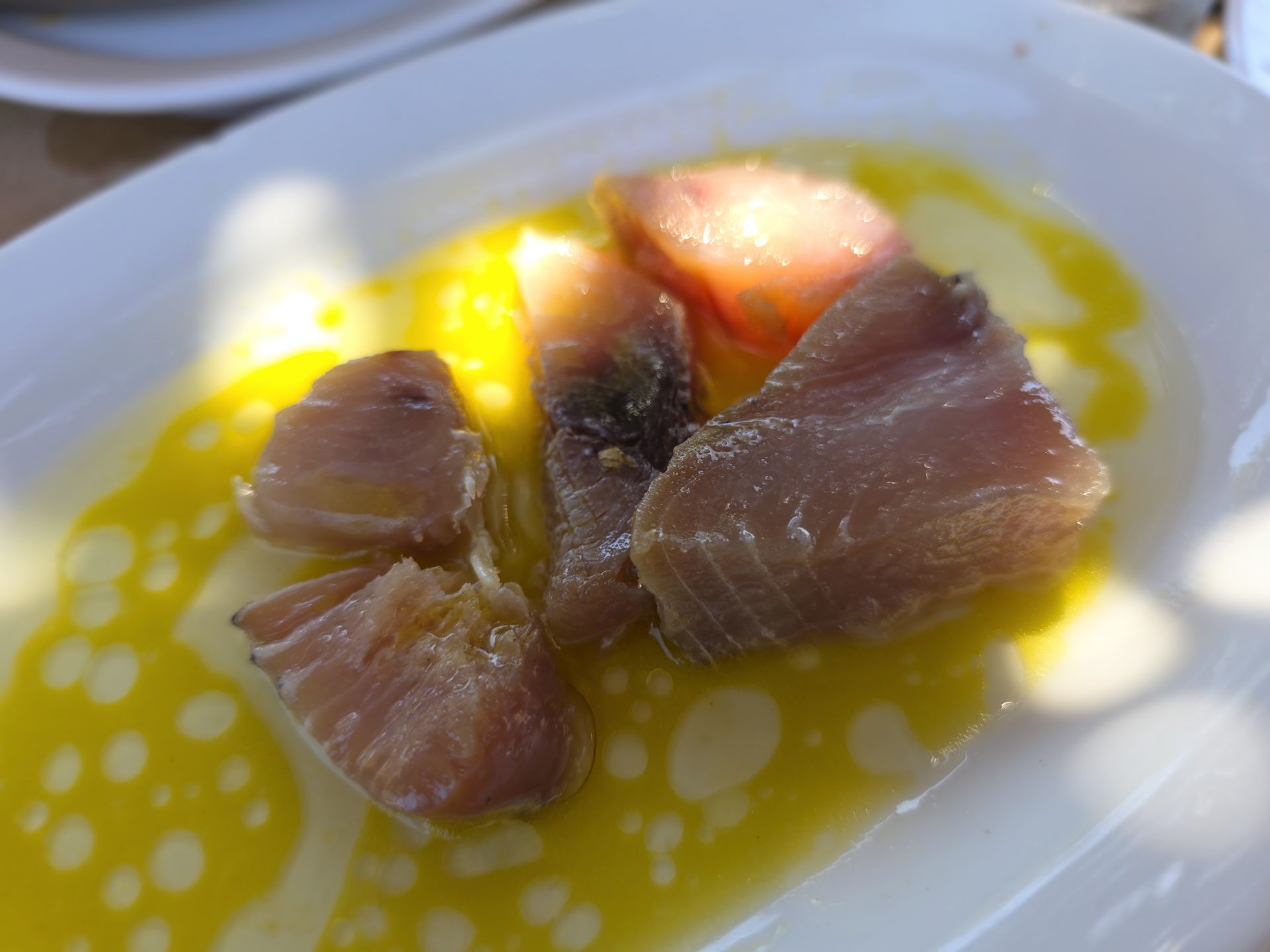
Der Pelamide, auch Atlantischer Bonito genannt, ist ein Fisch voller Geschichte und Aroma. In Griechenland gilt er als ideale Begleitung zu Tsipouro oder Ouzo – salzig, zart und unverkennbar im Geschmack.
Griechisch kochen – Dieses Rezept zeigt dir Schritt für Schritt, wie du den Pelamide kunstvoll einlegst, um eine delikate Vorspeise mit mediterraner Seele zu kreieren.
ZUTATEN
1 Pelamide (Atlantischer Bonito)
Meersalz, grob
Eiswürfel
Wasser, kalt
Zum Servieren:
Olivenöl
Zitronenspalten
Rote Zwiebel
Schwarze oder grüne Oliven
Rote Pfefferkörner
Zuerst den Kopf und die Flossen entfernen, dann den Bauch einschneiden und die Eingeweide sorgfältig herausnehmen. Den Pelamide gründlich mit Wasser abspülen und anschließend mit Küchenpapier trocken tupfen. Nun den Fisch in drei bis vier Stücke teilen und in eine Schüssel mit kaltem Wasser legen. Etwas grobes Meersalz und Eiswürfel hinzufügen und die Stücke ein bis zwei Tage im Kühlschrank lagern, dabei das Wasser regelmäßig wechseln, bis der Fisch vollständig ausgeblutet ist.
Im nächsten Schritt wird der Fisch erneut abgetrocknet. Mit einer langen Nadel oder einem dünnen Draht das Rückenmark von der Mittelgräte lösen – nur so kann das Salz später gleichmäßig einziehen und unangenehmer Geruch vermieden werden. Danach die Stücke wieder mit Wasser spülen und sorgfältig trocknen.
Eine Glasschüssel mit einer Schicht Salz vorbereiten, die Fischstücke darauflegen und vollständig mit grobem Salz bedecken. Die Schüssel abdecken und etwa zehn Tage im Kühlschrank ruhen lassen. Je nach Dicke kann die Einsalzzeit etwas variieren. Nach dem Pökeln den Fisch aus dem Salz nehmen, abspülen und in frischem Wasser einen weiteren Tag im Kühlschrank wässern, wobei das Wasser alle fünf Stunden gewechselt werden sollte.
Zum Servieren den Fisch entlang der Gräte einschneiden, die Mittelgräte entfernen und das Filet in dünne Scheiben schneiden. Mit Olivenöl beträufeln, mit roten Zwiebelringen, Pfefferkörnern, Oliven und Zitronenspalten anrichten – ein perfekter Meze-Moment zu einem Glas Tsipouro oder Ouzo. (sp)
Von HB-Redakteurin und Food-Bloggerin Sofia Papadopoulou

Greek Fish Art: The Pelamide refined in Salt
The Pelamide, also known as Atlantic Bonito, is a fish full of history and aroma. In Greece, it is considered the ideal companion to Tsipouro or Ouzo – salty, tender, and unmistakable in taste.
This recipe shows you step by step how to artfully cure the Pelamide to create a delicate appetizer with a Mediterranean soul.
Ingredients
1 Pelamide (Atlantic Bonito)
Coarse sea salt
Ice cubes
Cold water
For serving:
Olive oil
Lemon wedges
Red onion
Black or green olives
Red peppercorns
First, remove the head and fins, then slit open the belly and carefully remove the entrails. Rinse the Pelamide thoroughly with water and pat dry with kitchen paper. Cut the fish into three or four pieces and place them in a bowl of cold water. Add a little coarse sea salt and ice cubes, then refrigerate the pieces for one to two days, changing the water regularly until the fish is completely bled out.
Next, dry the fish again. Using a long needle or thin wire, remove the spinal cord from the backbone – this ensures the salt can penetrate evenly and prevents unpleasant odors. Rinse the pieces once more and dry thoroughly.
Prepare a glass bowl with a layer of salt, place the fish pieces inside, and cover completely with coarse salt. Cover the bowl and refrigerate for about ten days. Depending on the thickness, the salting time may vary. After curing, remove the fish from the salt, rinse well, and soak in fresh water for another day in the refrigerator, changing the water every five hours.
To serve, slice the fish along the backbone, remove it, and cut the fillets into thin slices. Drizzle with olive oil, garnish with red onion rings, peppercorns, olives, and lemon wedges – a perfect meze moment to enjoy with a glass of Tsipouro or Ouzo.
Ελληνική Τέχνη Ψαριού: Ο Παλαμίδης Αρωματισμένος με Αλάτι
Ο Παλαμίδης, γνωστός και ως Ατλαντικός Μπρονίτο, είναι ένα ψάρι γεμάτο ιστορία και άρωμα. Στην Ελλάδα θεωρείται ο ιδανικός συνοδός για τσίπουρο ή ούζο – αλμυρός, τρυφερός και με γεύση που δεν ξεχνιέται.
Αυτή η συνταγή σου δείχνει βήμα-βήμα πώς να παστώσεις τον Παλαμίδη με τέχνη, ώστε να δημιουργήσεις έναν εκλεπτυσμένο μεζέ με μεσογειακή ψυχή.
Υλικά
1 Παλαμίδης (Ατλαντικός Μπρονίτο)
Χοντρό θαλασσινό αλάτι
Πάγος
Κρύο νερό
Για το σερβίρισμα:
Ελαιόλαδο
Λεμόνι σε φέτες
Κόκκινο κρεμμύδι
Μαύρες ή πράσινες ελιές
Κόκκοι κόκκινου πιπεριού
Αρχικά αφαιρούμε το κεφάλι και τα πτερύγια, χαράζουμε την κοιλιά και βγάζουμε προσεκτικά τα εντόσθια. Ξεπλένουμε καλά τον Παλαμίδη με νερό και τον στεγνώνουμε με χαρτί κουζίνας. Κόβουμε το ψάρι σε τρία ή τέσσερα κομμάτια και τα βάζουμε σε ένα μπολ με κρύο νερό. Προσθέτουμε λίγο χοντρό αλάτι και πάγο και τα αφήνουμε στο ψυγείο για μία με δύο μέρες, αλλάζοντας συχνά το νερό, μέχρι να σταματήσει εντελώς το αίμα.
Στη συνέχεια στεγνώνουμε ξανά το ψάρι. Με μια μακριά βελόνα ή λεπτό σύρμα αφαιρούμε τον νωτιαίο μυελό από τη ραχοκοκαλιά – έτσι το αλάτι θα εισχωρήσει ομοιόμορφα και αποφεύγεται η δυσάρεστη οσμή. Ξεπλένουμε πάλι και στεγνώνουμε καλά.
Σε ένα γυάλινο σκεύος βάζουμε μια στρώση αλάτι, τοποθετούμε τα κομμάτια του ψαριού και τα καλύπτουμε εντελώς με χοντρό αλάτι. Σκεπάζουμε το σκεύος και τοποθετούμε στο ψυγείο για περίπου δέκα ημέρες. Ανάλογα με το πάχος, ο χρόνος παστώματος μπορεί να διαφέρει. Μετά το πάστωμα, αφαιρούμε τον Παλαμίδη από το αλάτι, τον ξεπλένουμε καλά και τον αφήνουμε σε φρέσκο νερό για ακόμη μία μέρα στο ψυγείο, αλλάζοντας το νερό κάθε πέντε ώρες.
Για το σερβίρισμα, χαράζουμε τον Παλαμίδη κατά μήκος της ραχοκοκαλιάς, αφαιρούμε το κόκαλο και κόβουμε τα φιλέτα σε λεπτές φέτες. Περιχύνουμε με ελαιόλαδο, γαρνίρουμε με κόκκινο κρεμμύδι, πιπέρι, ελιές και λεμόνι – ένας τέλειος μεζές για ένα ποτήρι τσίπουρο ή ούζο.